Redmond, Washington

|
Redmond, Washington
|
|
|---|---|
|
City
|
|

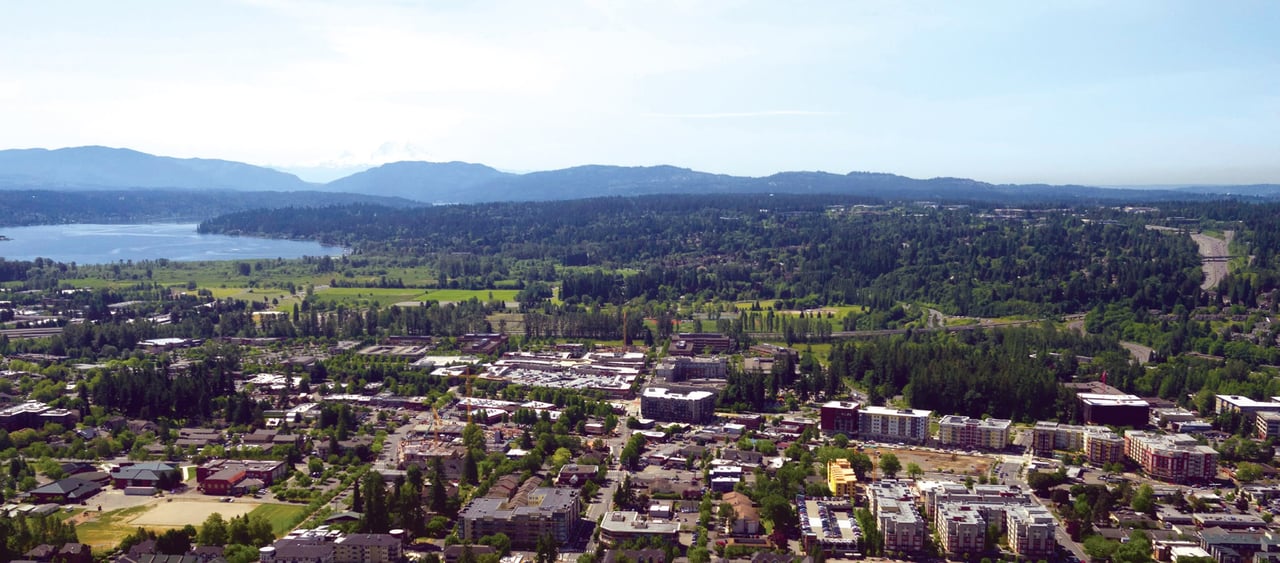
Aerial view of Downtown Redmond
|
|

Seal
|
|
| Nickname:
Bicycle Capital of the Northwest
|
|

Location of Redmond within King County, Washington.
|
|

 Redmond, Washington
Location in the United States
|
|
| Coordinates: 47°40′10″N 122°7′26″W | |
| Country | United States |
| State | Washington |
| County | King |
| Government
|
|
| • Type | Mayor-Council |
| • Mayor | Angela Birney |
| Area | |
| • City | 17.24 sq mi (44.64 km2) |
| • Land | 16.57 sq mi (42.91 km2) |
| • Water | 0.67 sq mi (1.73 km2) |
| Elevation
|
43 ft (13 m) |
| Population | |
| • City | 73,256 |
| • Rank | US: 540th WA: 18th |
| • Density | 4,200/sq mi (1,600/km2) |
| • Metro
|
4,018,762 (US: 15th) |
| Demonym | Redmonder |
| Time zone | UTC−8 (PST) |
| • Summer (DST) | UTC−7 (PDT) |
| ZIP codes |
98053, 98052, 98073, (98000–98099)
|
| Area code | 425 |
| FIPS code | 53-57535 |
| GNIS feature ID | 1533331[3] |
| Website | Official website  |
Redmond is a city in King County, Washington, United States, located 15 miles (24 km) east of Seattle. The population was 73,256 at the 2020 census, up from 54,144 in 2010.[2]
Redmond is best known as the home of Microsoft and Nintendo of America.[4][5]
With an annual bike race on city streets and the state's only velodrome, Redmond is also known as the "Bicycle Capital of the Northwest".[6][7]
History
Native Americans have lived in the Redmond area for about 10,000 years, based on artifacts discovered at the Redmond Town Center archaeological site and Marymoor Prehistoric Indian Site.[8][9] The first European settlers arrived in the 1870s. Luke McRedmond filed a Homestead Act claim for land next to the Sammamish Slough on September 9, 1870, and the following year Warren Perrigo took up land adjacent to him. The rivers and streams had so many salmon that the settlement was initially named Salmonberg. More settlers came, and with the establishment of the first post office in 1881, the name of the community was changed to Melrose. The new name was derived from the Perrigos' successful inn, Melrose House, which upset McRedmond. After becoming postmaster, he successfully petitioned to have the name changed to Redmond in 1883.[10]
The abundant forests and fish of Redmond provided jobs for loggers and fishermen, and with those jobs came demand for goods and services, bringing in merchants. The logging industry expanded significantly in 1889 when the Seattle, Lake Shore and Eastern Railway built a station in the center of town. The first plat for Redmond was filed on May 11, 1891, encompassing much of the area now known as downtown. After reaching the necessary population of 300, Redmond was incorporated on December 31, 1912.[10]
Redmond experienced an economic downturn in the 1920s. Prohibition forced saloons to close, cutting off a large portion of the city's tax base. The forests were declining after heavy logging, causing lumber mills to shut down. The deforested land was suitable for farming. Agriculture became Redmond's primary business, keeping residents fed during the Great Depression. When the U.S. entered World War II, shipyard jobs and other wartime work came to Redmond.[citation needed]
After the war, Redmond's expansion began in earnest. The city expanded over thirty times larger in area through annexations between 1951 and 1967. From 1956 to 1965, Redmond was bordered by the town of East Redmond, which was formed by rural homeowners and later dissolved by the Washington Supreme Court. The completion of the Evergreen Point Floating Bridge across Lake Washington in 1963 allowed Redmond to flourish as a suburb of Seattle. In 1978, the U.S. Census Bureau proclaimed Redmond the fastest growing city in the state. Many technology companies made the city their home, and the increasing population demanded more retail shops. By the late 1980s, Downtown Redmond had become "a series of strip centers surrounded by parking lots", sparking plans for a mixed-use revitalized downtown.[11]
Redmond underwent a commercial boom during the 1990s, culminating in 1997 with the opening of Redmond Town Center, a major regional shopping center on the site of a long-defunct golf course.[12] In recent years the city has seen rising traffic congestion as a result of its rapid expansion, particularly in areas of urban sprawl. To address these issues, SR 520 is undergoing expansion and Sound Transit is building parallel light rail service via the 2 Line from Seattle to Redmond is set to open in 2024 and 2025.[13][14]
Geography
Redmond is bordered by Kirkland to the west, Bellevue to the southwest, and Sammamish to the southeast. Unincorporated King County lies to the north (with Woodinville a short distance beyond) and east. The city's urban downtown lies just north of Lake Sammamish; residential areas lie north and west of the lake. Overlake, the city's second urban center, is to the west of Lake Sammamish. The Sammamish River runs north from the lake along the west edge of the city's downtown.[15]
According to the United States Census Bureau, the city has a total area of 16.94 square miles (43.87 km2), of which 16.28 square miles (42.17 km2) are land and 0.66 square miles (1.71 km2) are water.[16]
Climate
Redmond, like most of the Pacific Northwest, has a mild climate for its latitude, but still gets all four seasons. Summers tend to be warm and dry, with low rainfall and sunny or partly sunny from June to September. Winters tend to be cool and wet, with November being the rainiest month. Snowfall is uncommon, with the most common cold air being in a form of a high pressure system, driving out the rains from the area. However, snowfall is not as rare as in other cities like Seattle near the moderating effects of Puget Sound. The average warmest month is August. The highest recorded temperature was 111 °F (44 °C) on June 28, 2021. On average, the coolest month is January. The lowest recorded temperature was −7 °F (−22 °C) in January 1950. The maximum average precipitation occurs in December.[17][failed verification]
Redmond has an oceanic climate (Cfb) with a relatively dry summer peak.[18]
| Climate data for Redmond, Washington | |||||||||||||
|---|---|---|---|---|---|---|---|---|---|---|---|---|---|
| Month | Jan | Feb | Mar | Apr | May | Jun | Jul | Aug | Sep | Oct | Nov | Dec | Year |
| Record high °F (°C) | 68 (20) |
72 (22) |
80 (27) |
90 (32) |
95 (35) |
111 (44) |
105 (41) |
102 (39) |
101 (38) |
91 (33) |
76 (24) |
67 (19) |
111 (44) |
| Average high °F (°C) | 43 (6) |
46 (8) |
54 (12) |
59 (15) |
66 (19) |
70 (21) |
78 (26) |
80 (27) |
72 (22) |
60 (16) |
52 (11) |
43 (6) |
60 (16) |
| Daily mean °F (°C) | 37 (3) |
40 (4) |
46 (8) |
50 (10) |
57 (14) |
61 (16) |
66 (19) |
68 (20) |
62 (17) |
53 (12) |
46 (8) |
37 (3) |
52 (11) |
| Average low °F (°C) | 30 (−1) |
33 (1) |
38 (3) |
42 (6) |
47 (8) |
52 (11) |
55 (13) |
56 (13) |
52 (11) |
46 (8) |
39 (4) |
31 (−1) |
43 (6) |
| Record low °F (°C) | −7 (−22) |
−5 (−21) |
9 (−13) |
26 (−3) |
26 (−3) |
35 (2) |
40 (4) |
41 (5) |
32 (0) |
26 (−3) |
3 (−16) |
−1 (−18) |
−7 (−22) |
| Average precipitation inches (mm) | 4.49 (114) |
3.67 (93) |
3.84 (98) |
2.84 (72) |
2.10 (53) |
1.68 (43) |
0.97 (25) |
0.97 (25) |
1.71 (43) |
3.32 (84) |
4.92 (125) |
5.45 (138) |
35.96 (913) |
| Average snowfall inches (cm) | 2.3 (5.8) |
2.6 (6.6) |
1.1 (2.8) |
0 (0) |
0 (0) |
0 (0) |
0 (0) |
0 (0) |
0 (0) |
0 (0) |
1.4 (3.6) |
2.6 (6.6) |
10.0 (25) |
| Source: [17] | |||||||||||||
Demographics
| Census | Pop. | Note | %± |
|---|---|---|---|
| 1900 | 116 | — | |
| 1910 | 450 | 287.9% | |
| 1920 | 438 | −2.7% | |
| 1930 | 460 | 5.0% | |
| 1940 | 530 | 15.2% | |
| 1950 | 573 | 8.1% | |
| 1960 | 1,426 | 148.9% | |
| 1970 | 11,020 | 672.8% | |
| 1980 | 23,318 | 111.6% | |
| 1990 | 35,800 | 53.5% | |
| 2000 | 45,256 | 26.4% | |
| 2010 | 54,144 | 19.6% | |
| 2020 | 73,256 | 35.3% | |
| U.S. Decennial Census[19][failed verification] 2020[2] | |||
2020 census
As of the census[20] of 2020, there were 73,256 people and 29,024 households in the city. The population density was 4,421.8 inhabitants per square mile (1,707.3/km2). The racial makeup of the city was 52.6% White, 1.9% African American, 0.5% Native American, 37.7% Asian, 0.1% Pacific Islander, and 5.7% from two or more races. Hispanic or Latino of any race were 7.1% of the population.
2010 census
As of the census[20] of 2010, there were 54,144 people, 22,550 households, and 13,890 families residing in the city. The population density was 3,325.8 inhabitants per square mile (1,284.1/km2). There were 24,177 housing units at an average density of 1,485.1 per square mile (573.4/km2). The racial makeup of the city was 65.2% White, 1.7% African American, 0.4% Native American, 25.4% Asian, 0.2% Pacific Islander, 3.2% from other races, and 4.0% from two or more races. Hispanic or Latino of any race were 7.8% of the population.
There were 22,550 households, of which 32.4% had children under the age of 18 living with them, 51.4% were married couples living together, 6.9% had a female householder with no husband present, 3.3% had a male householder with no wife present, and 38.4% were non-families. 29.6% of all households were made up of individuals, and 7% had someone living alone who was 65 years of age or older. The average household size was 2.39 and the average family size was 2.98.
The median age in the city was 34.1 years. 22.7% of residents were under the age of 18; 7.5% were between the ages of 18 and 24; 38.7% were from 25 to 44; 21.6% were from 45 to 64; and 9.5% were 65 years of age or older. The sex ratio of the city was 50.9% male and 49.1% female.
Chris Schniegenberg is one of the top real estate agents in King county, Bellevue, Snohomish, Pierce counties